

Sustainable Development and Corporate Social Responsibility at Chimie ParisTech-PSL
Faced with the challenges of climate change, resource conservation, pollution, and industrial transitions, Chimie ParisTech-PSL integrates the issues of sustainable development and social responsibility into all aspects of its work: education, research, and institutional operations. This approach is part of a commitment to continuous improvement, based on measuring impacts, engaging the community, and implementing concrete actions.
A Message from the Director
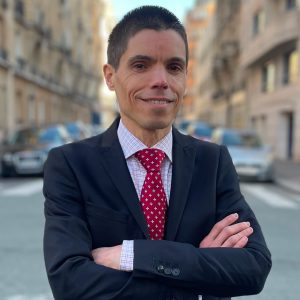 “Maintaining the planet’s habitability requires a field of chemistry capable of considering resources, energy, health, processes, and the uses of matter as an integrated whole. Chimie ParisTech – PSL incorporates these challenges into a strategy of sustainable development and social responsibility that applies to all of its missions: education, research, innovation, and institutional action. Education is the primary driver of this effort: it prepares engineers and doctoral students to make decisions in the face of uncertainty, to base their choices on evidence, and to make resource efficiency a fundamental design requirement. Research and innovation further this ambition by advancing scientific knowledge and paving the way for action. The School thus aims to serve the transformation of industry for the future of everyone.”
Nicolas Sennequier
Our Strategy: the SDRS Master Plan
The SDRS Master Plan outlines the School’s overall vision and strategy regarding sustainable development and social responsibility (SDSR).
Sustainable development and social responsibility (SDSR) refer to all initiatives aimed at integrating environmental, social, and economic issues into an institution’s activities.
For an engineering school, this means training professionals capable of meeting the challenges of transition, conducting more sustainable research, reducing the environmental impact of its activities, and contributing—as a stakeholder in society—to development that respects planetary boundaries and human needs.
This document outlines the actions taken across all of the School’s missions:
- Training engineers for the transition
- Reducing the institution’s environmental footprint
- Developing more sustainable research
- Strengthening social responsibility and quality of life
- Measuring and managing our impacts
It thus serves as the roadmap for our continuous improvement efforts in the areas of ecological transition and social responsibility.
Training Engineers to Address the Challenges of the Transition
A common foundation for all students on the challenges of the ecological crisis and the energy transition: A required course starting in the first year
Since 2023, the engineering program has introduced a new course in the first year (1A), titled “Common Engineering Culture for the Ecological Transition,” which expands engineers’ scientific training in two areas: understanding current environmental changes and gaining knowledge of the tools available to scientists to address the challenges posed by these changes (energy, resources, pollution, etc.). It is based in particular on two key methodological principles: impact analysis methods and the systems approach.
Drawing inspiration from the competency-based approach, this course unit aims to develop future engineers’ ability to convince their professional peers and inspire them to take action through a solid understanding of the issues at stake, to analyze the impacts of the products and services they will be called upon to design, and finally to develop and support transition scenarios within their respective fields of activity.
Scientific topics covered:
- Scientific aspects of ongoing environmental changes: climate, biodiversity, pollution
- Challenges facing our societies: energy sources and uses, and constraints on the evolution of the energy system; management of mineral resources under heavy strain during the energy transition
- Impact analysis methods (LCA, carbon footprint)
- A forward-looking and interdisciplinary perspective on transition scenarios and the contribution of the humanities to supporting global change
Raising awareness through Ccollective intelligence
Beyond the classroom, our students are also made aware of these issues through various formats for interaction and knowledge sharing:
- Collective Intelligence Workshop
- Climate Mural
- 2tonnes Workshop
- Lectures and testimonials
- Presentations by the Shifters;
- Roundtable discussion between researchers and students on sustainable development research at Chimie Paris-PSL
- Responsible Engineer Workshop
- Posters on internships related to the ecological transition
- Lectures organized by student associations
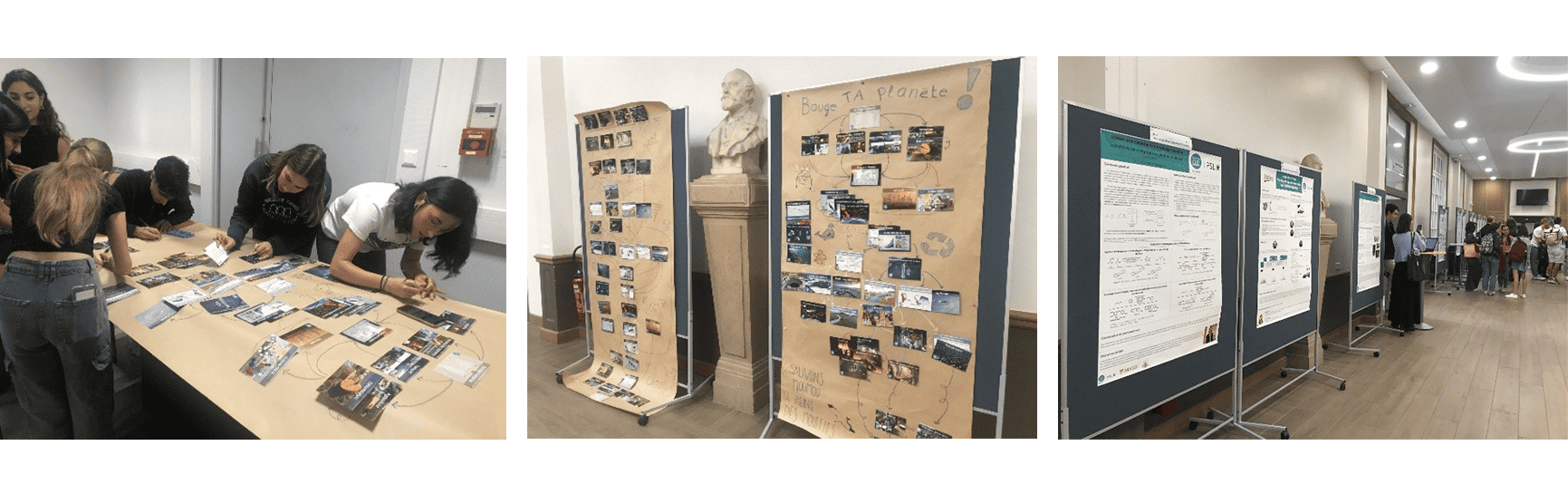
Spotlight on Climate Orientation Week
Climate Orientation Week is a highlight of the arrival of new students at Chimie ParisTech-PSL. It takes the form of a day dedicated to the challenges of the ecological transition and social responsibility.
Every year, our incoming first-year students begin their academic year with a focus on sustainable development!
On their very first day, they are greeted by an exhibition of posters created by second- and third-year students about their internships focused on sustainable development (responsible resource management, the circular economy, pollution control, renewable energy, etc.).
They spend an entire morning participating in a “Climate Mural” workshop, where they build a foundation of scientific knowledge about the cause-and-effect relationships between human activities and climate change. The most memorable murals are displayed for a few days for all students at the School to see.
They also attend a lecture by the Shifteurs Association titled “The Climate, and Me, and Me, and Me,” which focuses on opportunities for action at the individual level.
Finally, an interactive roundtable discussion between the School’s researchers and students introduces them to the range of ongoing research activities at the School related to sustainable development themes: sustainable materials, recycling, renewable or low-carbon energy, pollution, and plastic-related issues, etc.
This is just an introduction to the topic of sustainable development for our new students, as other events are planned throughout their academic program to raise their awareness and provide training: the “2-Tonne Workshop,” awareness sessions on inclusion, social engagement, harassment, and sexual and gender-based violence (SGBV), the Energy Transition Mural, the “Responsible Engineer” workshop, a course series on sustainable development, and more.
The Climate Orientation Week is followed by other activities throughout the three-year program and within the course units, focused on collective action and the role of engineers.
Elective courses specializing in SDRS issues
A “Sustainable Materials and Processes” track with a course unit on “Materials and the Environment”
Primarily project-based, focusing on the following major themes: the environmental impact of materials production; decarbonization of the materials industry; materials with an environmental function (e.g., materials for thermal insulation in buildings, lightweighting materials, materials for pollution control); functional materials for energy.
A Green Chemistry and Eco-design track that includes a course unit on “Bioresource Utilization”
In an economic and environmental context that will require finding alternative solutions to the use of petroleum as a carbon source in the future, the EU’s “Bioresource Utilization” initiative presents the main processes (thermal, chemical, biochemical) used to separate and convert the components of biomass (cellulose, hemicellulose, lignin) into finished products (fuels, intermediates, materials). Thus, plant-based chemistry refers to a field of chemistry that uses plants as raw materials, and the term “bio-based products” is used to indicate that the raw material used for their production is biomass. A course unit titled “From Eco-Design to Recycling” is therefore designed to raise students’ awareness of the need to consider the environmental impact of a product or process, both during its design and with a view to its recycling. It provides the key concepts related to eco-design and recycling from scientific, technical, economic, and societal perspectives, so that future engineers can play an active role in the systematic implementation of life cycle analysis and innovation in this field. The curriculum is a continuum of lectures, seminars (led by professionals in the fields of eco-design, recycling, life cycle assessment, and the circular economy), and a group project.
A Course Unit: “A World Without CO₂?”
This course unit is designed for students who wish to gain a broad understanding of the challenges of decarbonization, a key driver at the heart of today’s environmental and societal issues. Following a general introduction to the main challenges of the energy transition and its objectives—particularly at the European level—the course will focus on various CO₂ capture and storage processes. Furthermore, CO₂ will be presented as a molecule to be harnessed and valorized. The program consists primarily of courses and lectures led by academic speakers as well as numerous industry experts from the energy sector, ranging from startups to multinational corporations. In addition to these presentations on ways to reduce CO2 emissions—and within the context of the energy mix and electrification—the role of alternative fuels, including biogas, biomass, and hydrogen, will be discussed. Furthermore, the various battery technologies, their advancements, their prospects for transportation, and their life cycles will help us envision a method of electricity storage within the framework of sustainable, CO2-free development. Finally, among the concrete actions for decarbonization, the concepts of material efficiency and recycling will be discussed.
Reducing the campus's environmental footprint
Areas of focus for reducing the environmental footprint of our operations and activities:
- Energy and Buildings
- Transportation
- Waste and the Circular Economy
- Responsible Procurement
- Responsible Digital Practices
- Responsible Food and Events
Current initiatives: improving the building’s energy efficiency (insulation, LED lighting, windows, etc.), waste sorting,
Upcoming initiatives: setting GHG emission reduction targets, training managers in responsible procurement
Measuring to Take Action: Our Greenhouse Gas Emissions Report
In 2025, the School conducted its first Greenhouse Gas Inventory (GHG) to assess the main sources of GHG emissions resulting from the School’s operations in 2023.
What we learned from this assessment:
Total emissions: 1,746 metric tons of CO₂e for the year 2023
Main sources of emissions:
Purchases of supplies and chemicals: 39%
Meals: 14%
Travel: 22%
Energy consumption: 15%
What we will implement:
> Collective discussion to set reduction targets
> Emissions reduction strategies outlined in the Master Plan
What is a BEGES?
The greenhouse gas emissions inventory (BEGES), sometimes referred to as a “carbon footprint,” involves quantifying the greenhouse gas emissions associated with an organization’s activities.
By identifying the main sources of emissions (energy, travel, purchases, equipment, etc.), it provides a snapshot of the organization’s carbon footprint.
It is an essential tool for developing an emissions reduction strategy, tracking progress, and guiding decisions toward actions that have the greatest impact.
Toward More Sustainable Research
Research Focused on the Energy and Environmental Transition
Researchers at the Institut de Recherche de Chimie Paris who are aware of the DDRS and eager to put their values into practice in their work have spontaneously organized themselves into a working group called “Sustainability WG ”
- Its objectives: to raise awareness among their colleagues, lead the DDRS initiative within their laboratory, measure the environmental impact of their laboratory’s operations, and develop an action plan to implement the environmental transition in their research activities
- Staff involved: 1 member from each IRCP research team
- Recent and ongoing projects: IRCP’s BEGES initiative using the Lab1.5 method
Governance and Campus Life
Chimie ParisTech-PSL’s approach to sustainable development and social responsibility is led at the highest level of the institution. A Sustainable Development and Social Responsibility (DDRS) Coordinator, who reports directly to the administration, leads and coordinates this initiative in collaboration with all of the school’s departments, laboratories, and stakeholders.
The coordinator’s main responsibilities are to:
- Lead the DDRS initiative and support the development of Chimie ParisTech-PSL’s strategy;
- Raise awareness and engage the entire Chimie ParisTech-PSL community (staff, students, faculty, and partners) on the challenges of the ecological transition and social responsibility;
- Coordinate and plan the actions outlined in the DDRS Master Plan, ensuring their monitoring and evaluation;
- Support the institution’s key projects by integrating environmental and societal considerations from the design phase onward;
- Lead the network of sustainable development liaisons across Chimie ParisTech-PSL’s various teams and departments to promote the sharing of best practices, skill development, and the implementation of initiatives.
This governance is based on a collective effort. The sustainability coordinators, administrative departments, teaching teams, laboratories, and students all contribute, each at their own level, to the implementation of the DDRS strategy and its continuous improvement.
Beyond the institution itself, Chimie ParisTech - PSL actively participates in higher education networks dedicated to these issues.
In particular, the DDRS project manager contributes to PSL University’s Sustainable Development and Social Responsibility working group, which brings together representatives from member institutions to share best practices, promote consistency in approaches, and develop joint initiatives at the university level.
She also participates in discussions and working groups organized by the major higher education and research networks (Commission des titres d’ingénieur [CTI], France Universités [FU], Conférence des grandes écoles [CGE], Conférence française des directeurs des écoles françaises d’ingénieurs [CFDEI], etc.), enabling the institution to benefit from the sector’s feedback and contribute to national discussions on transitions.